A Reflection On The Two Different Immortal Life Album Covers
Between Beuys and Kippenberger

The archival releases Harmonium, Immortal Life and The Paranoiac Miracle / Eternal Void are now available.
Not everyone knows that there were actually two different album covers for the Immortal Life EP. The older of the two, which I used for the original hand-burned CD-R version, was an image of me sitting at my desk next to my laptop, guitars, drum machine and combo amp, with the Audacity session for the recording pulled up on the laptop screen, arms folded, blank, vacant look on my face. The word “LITURGY” is in outline gothic font at the bottom, and the track list is in centered type on the upper left corner.
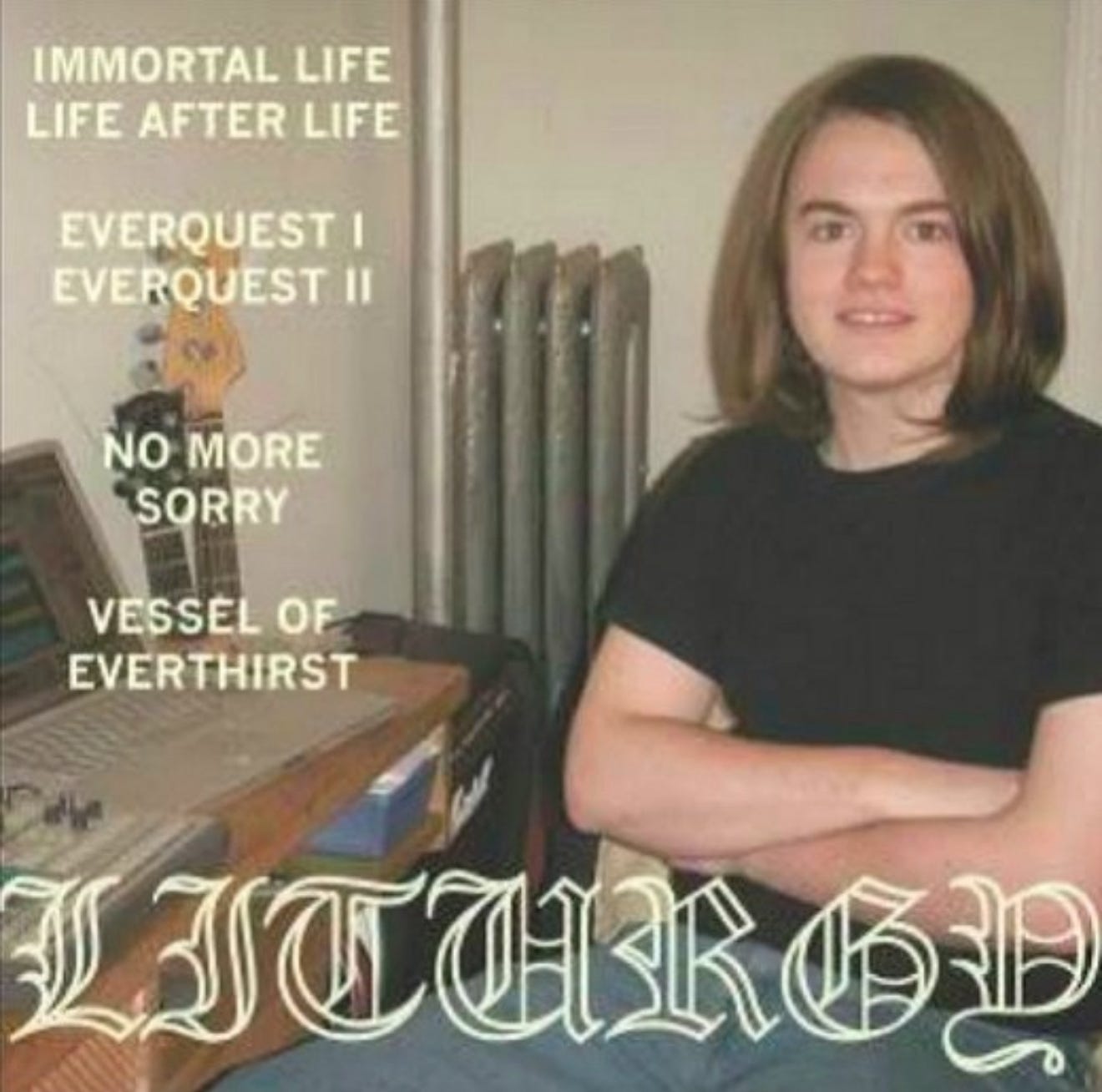
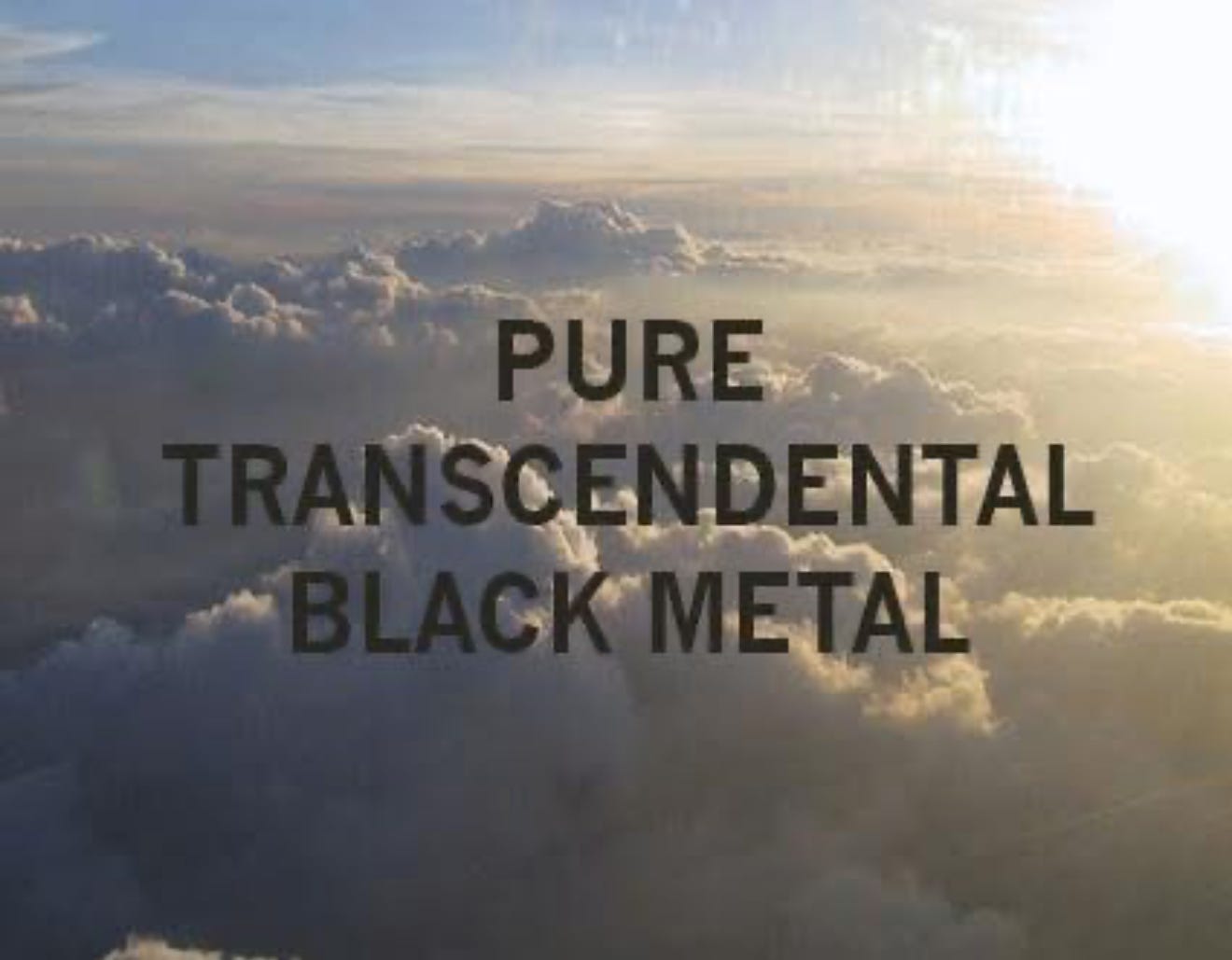
This is the bolder and I think more authentic of the two, though the cover I actually came up with first, the same few days as I recorded the My Bloody Valentine cover, is a heavenly image of clouds taken from an airplane above. I remember printing the words PURE TRANSCENDENTAL BLACK METAL in a thick black font over this image, which became the back cover, in the very same reverie during which I made the My Bloody Valentine track. The front cover is the exact same cloud image with the words LITURGY in a small font, IMMORTAL LIFE in a much bigger font, and, at the bottom, “created by Hunter Hunt-Hendrix”.
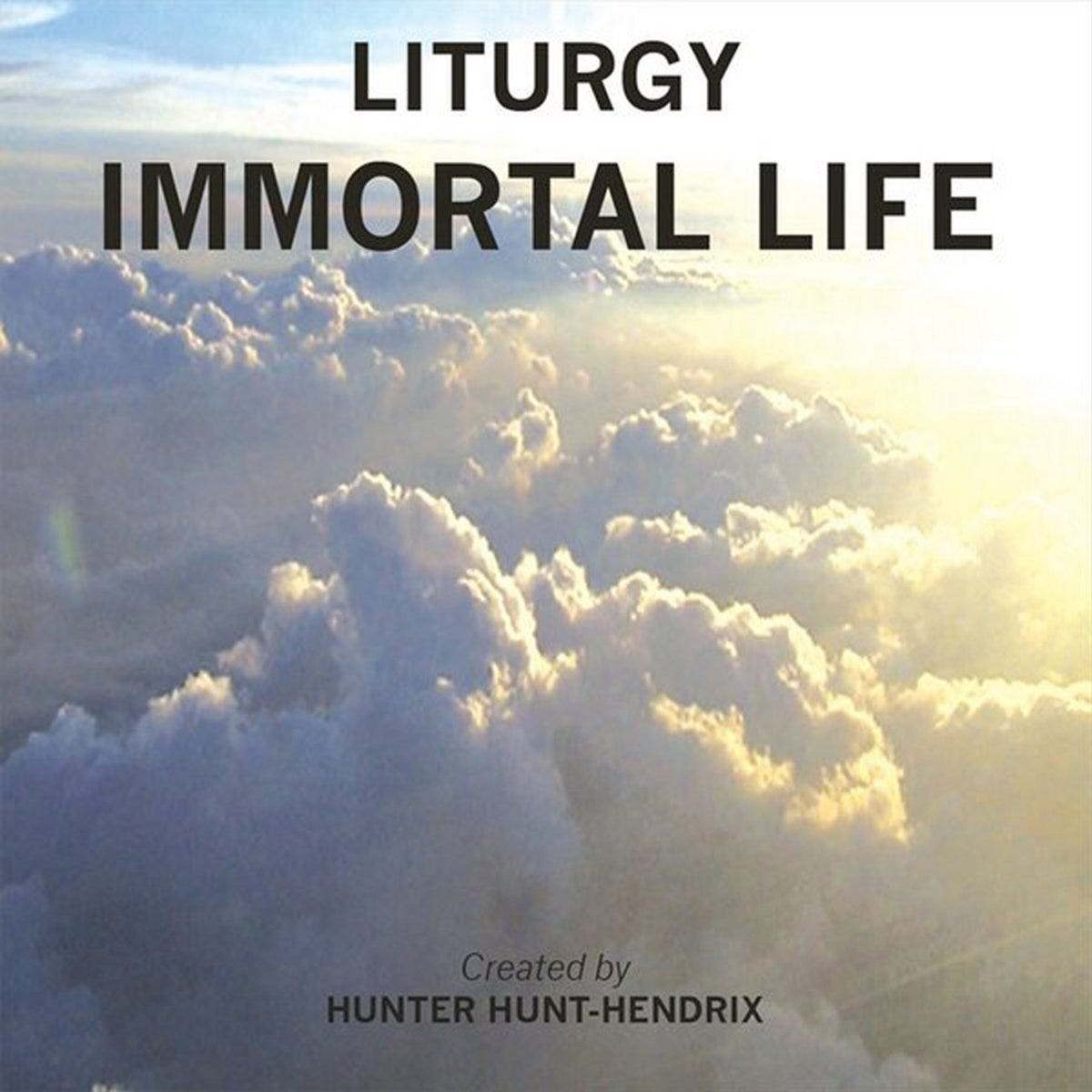
I was aware of how differently the two covers read, obviously: the first seems like a joke. When I had the opportunity to do a somewhat wider release, I was tortured over which image to use for more official Unfun version released in 2008, and the ultimate decision was to split the difference: I put the clouds on the front but the picture of me on the inside of the same sleeve. When it was actually pressed and released, however, I was intensely remorseful at the decision. The cloud image is much more obviously and iconically a visual analogue to the sound of the music, but I just felt it was too on the nose, too obvious.
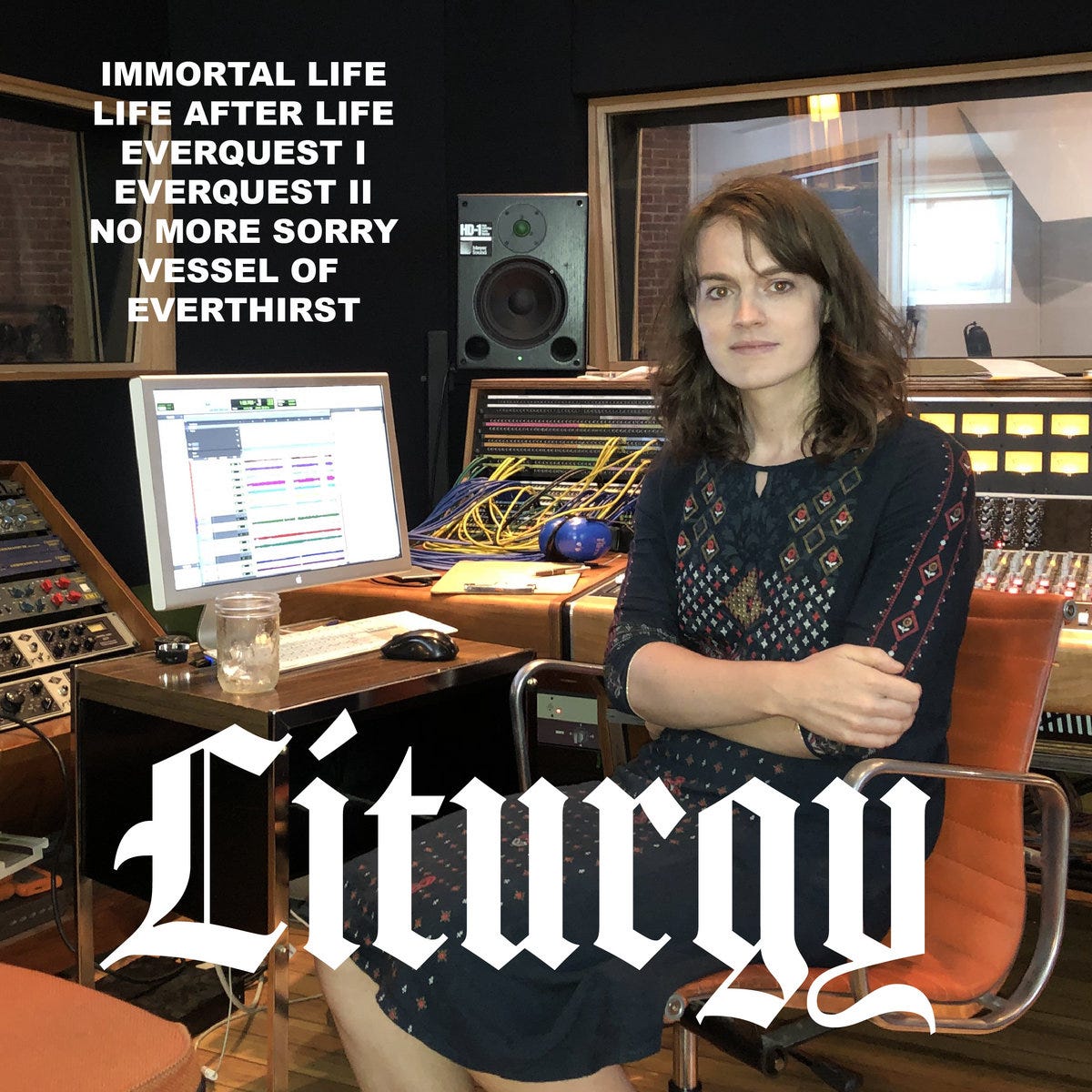
For 2024’s full-band remake of Immortal Life (recorded by the 93696 quartet) we recreated the 2007 image as a joke at Machines with Magnets, the studio where we recorded (photo by Mario Miron). The photo was just too good not to use, so it became the cover for the Immortal Life II release - a callback to the CD-R cover from when I was a teenager. That made the choice fairly simple regarding which of the two to use for the current re-release of the original EP.
But still, once again I’m a little remorseful that it isn’t possible to use both images at the same time. In a lot of ways these two covers visually represent two wolves that have always been inside of me regarding this project. One that seeks to be defiant, counterintuitive, a bit abject, at the edge of acceptable convention, interrogating identity, constituting a breach. The other wolf just wants to be as loving, beautiful, sincere, glorious and angelic as possible, to be totally legible as simply a spiritual music project, Arvo Part but louder.
Its easy to imagine a different timeline of my whole life where I take the more straightforwardly beautiful route, to simply seek to make psychedelic and powerful music like so many influences, MBV, Branca, Aaron Copeland, Scriabin etc, no critique, no interrogation of cultural materials. But I’ve always felt the need to swing between the two, to make The Ark Work after Aesthethica, to make Origin of the Alimonies after H.A.Q.Q., to alienate the new set of fans that accumulates around a release by subverting their expectations.
Why? I’ve often described a Nietschean ethical imperative I have to resist long-term transferential bonds, or an anti-careerist tendency. My music is very enchanting, but I always want to make sure I am pointing away from myself, towards God, as an icon in the properly Orthodox sense, rather than “icon” in the “rock music icon” sense where stars are basically worshipped as demigods by fans. To me it just feels healthy to show people that I’m not who they thought I was for a few years, to get them to go their own way.
When I put it like that it sounds Iike its something settled that I’m fully confident about, but in reality I’m always in a state of ambivalence about it. This surely in part goes back to my early initiation into art culture, when I felt torn between the archetypes of two artists I was became captivated by, Joseph Beuys and Martin Kippenberger (Beuys’s “Every human is an artist” and Kippenberger’s “Every artist is human” are juxtaposed in the album art of my 2015 The Ark Work album).
But the point I want to elaborate on here is that perhaps there were two wolves within black metal at the time, or within culture as such, whether “I” factored in or not. Who is this “I” after all? Following Randall Collins, whom I’ve been mentioning in the past few posts, from a certain perspective we are all not so much people as ‘interaction ritual chains’. Our incentives, narrative and actions are motivated by ecstatic or traumatic encounters the meaning of which exceeds us, which are downstream of social and technological unfoldments. And it was right around this time that black metal was making its appearance within the very different field - I’m using the word “field” in Bourdieu’s sense - of fine art, just as I myself was being initiated into this latter world.
I’m not sure exactly where I first saw Bjarne Melgaard’s work, I’m pretty sure it was during Rosalind Krauss’s 20th century art survey, which I took my freshman years with and at the encouragement of several friends who grew up to become either painters or curators. She happened to choose him as her main example of the current generation of contemporary art.
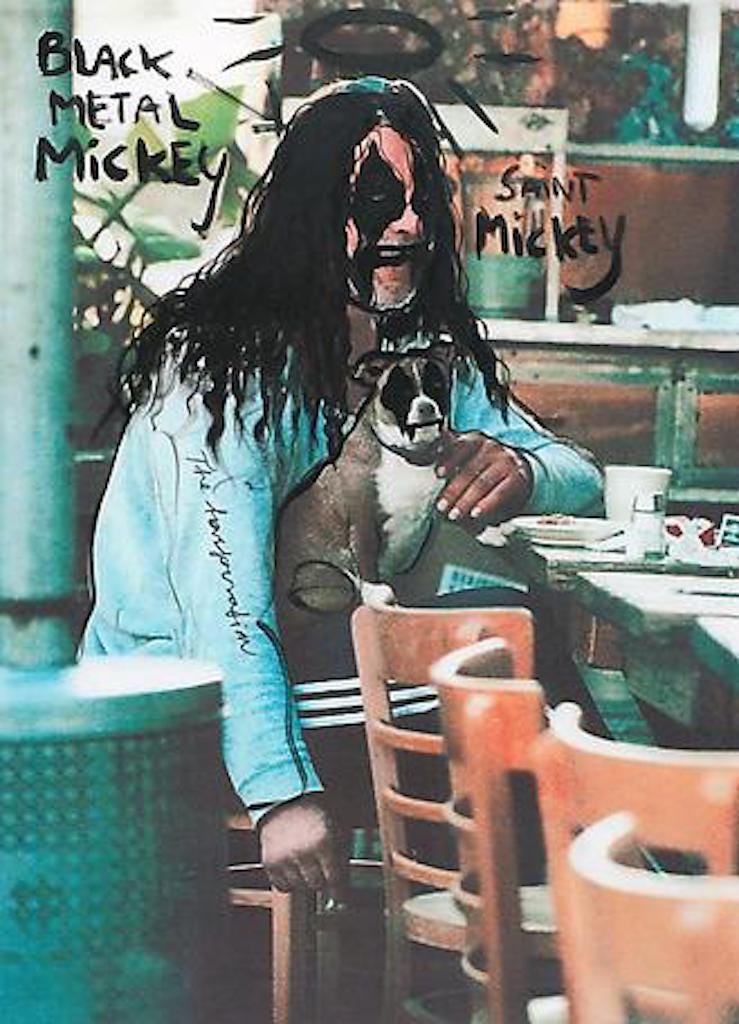
Or it might have been his 2004 solo exhibition at Reena Spaulings, the hugely influential gallery (slash ‘artist’ slash fictional character and entity generally committed to the subversion of authorship and identity). I’d forgotten that the show’s title was “The Concept of Rape” and am noticing as I draft this that its documentation is curiously missing from the Gallery’s exhibition history. Instead of pointing to images of the show like the links for Seth Price, Wade Guyton, and the younger artists who are my acquaintances like Julianna Huxtable and Marc Kokopeli (whose show from last year, I have to mention in passing, I thought was amazing), the Bjarne Melgaard link just goes to the (broken) url stabfrenzy.com. (Melgaard is a cancelled artist nowadays, though I’m unsure whether for justified reasons. I’m not close enough to the situation to have reviewed it.) I’m hazy on whether I saw this show in person - it would have been the same year that I took Krauss’s class - or whether I just saw documentation later.
Certainly being in the same room with Krauss at all for a semester, simply as a sheer ‘interaction ritual’, seeing how people treated her like a goddess basically (she was arguably the most influential art critic in the world at the time) influenced my questions, incentives, and sense of what kinds of materials are legitimate for aesthetic exploration. (In passing I’ll note that Krauss, along with her allies like Hal Foster that she assigned us to read hated Beuys and only brought him up to condemn him, which was difficult for me because I instinctively gravitated to much to his work. But Melgaard she liked.) I was already a fan of black metal in high school, and was especially inspired by the way bands like Pg. 99 and Reversal of Man incorporated its musical and visual aesthetics into screamo, which was the genre I was more immediately immersed in.
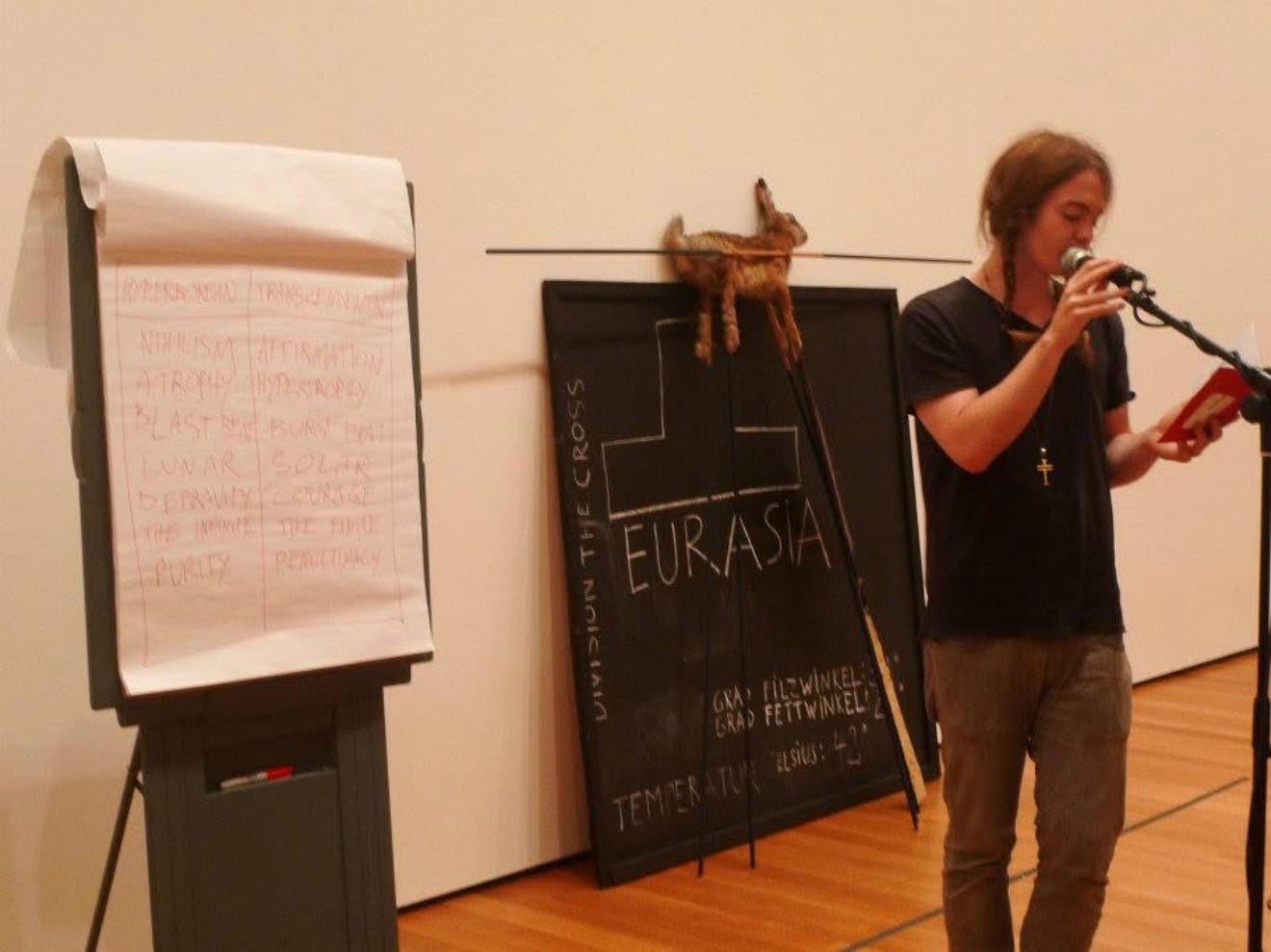
But my interest in it was enhanced further in sensing that black metal aesthetics were something to interrogate from the perspective of a highly intellectual and noncommercial art scene, that was populated by people who to put it candidly seemed to me to be almost superhumanly sophisticated - people like John Kelsey and John Miller. I won’t go down that whole rabbit whole here - but suffice it to say it is worth restating that this was an important context for me - this was the world that “got” Liturgy in a way that the music industry never has. I gave a lecture and performed with the band at MoMA with a group of Reena Spaulings artists, and at a Dan Graham exhibition at Greene Naftali and a Blake Rayne exhibition at Miguel Abreu (Blake was a Columbia professor while I was there), who for a time was selling my transcendental black metal text in their bookstore.
I didn’t study studio art as a practice, but because I was friends with so many people who did I was able to go to small talks available only to art students, where it was common for the artist to interrogate the format of the talk itself. Rirkrit Tiravanija came and just served us some soup with an ambient drone playing in the background. Andrea Fraser came and gave some kind of in-character fake talk, etcetera. The Bernadette Corporation in particular, a group adjacent to Reena Spaulings, which had already been active for a long time, distressed the distinctions between advertising, party culture, fine art, political leftism, fashion and modeling in this way that was very magical to me because it always seemed to be both critique and complicity at the same time. It just felt like true art to me, it was gesturing towards questions I’d simply never thought could be discussed.
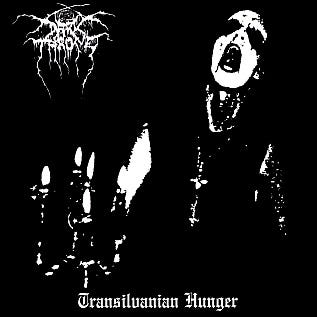
It was as a performance within this discursive field that I sought a kind of kenosis of the Transylvanian Hunger album cover (which I had as my Facebook pfp for years). The cover of that album features Fenriz in a black and white photo with corpse paint, a degraded or low quality photo, conveying a kind of impenetrable infinite distance. It is probably the black metal image. I loved it, but I was also fascinated by the gap between it and Fenriz the postal worker for the Norwegian mail service, or in any case the gap between me, the troubled kid in a dorm room, and the cosmic music I was making. I wanted to expose the person under the makeup, I wanted to reiterate the form in a personal, abject way, conveying a sort of exposure to my flaws and trauma, as well as to leverage the naive-seeming openness I’ve always seemed to emanate. Cindy Sherman was on my mind. A black metal in-and-for-itself, I thought, had to expose the fragile human context behind its creation. This would fulfill a kind of Clement Greenbergian imperative that the arts highlight their own medium specificity and perform their own disenchantment.
Now, this initial encounter between black metal art had already been going on for a few years. But its second-order transmission to wider culture (to say nothing of the third-order transmission into the “indie” music industry), which is to say a wider awareness of black metal’s appropriation into fine art outside of the art world, hadn’t happened yet. This happened in 2009, after my low-fi recordings. You might be familiar with that year’s Until the Light Takes Us documentary, with the famous scene where Fenriz awkwardly walks through a Melgaard exhibition and reacts unfavorably. That movie (and its directors invited me to perform at its NYC opening that year, which was one of the Renihilation-era quartet’s first shows) became quite famous. It created I think an unfair sense in the wider world of an out-of-touch art world appropriating black metal in an unjustified way. As though black metal were homegrown and authentic while the art world were a bunch of carpetbaggers, which I think is a totally childish view, and performs the exact self-satisfied closemindedness that both fields challenge.
In any case, and I’ll begin to wrap up this post with this point, what is crucial to stress is that I was neither fully on board with the fine art side of things nor the black metal side of things. I’m not part of the art world, any more than I’m part of the black metal scene, but early Liturgy can’t be understood without understanding my daily interaction with it during this period. The ideas as well as the openings, afterparties, social hierarchies, which I constantly had a taste of from a peripheral position.
What Melgaard seemed interested in was the extremity of pure negation, as expressed in violent, queer and BDSM culture generally. We should remember that art is generally ahead of philosophy chronologically (just like music is generally, in the best of cases, ahead of art), and that Melgaard was really the anticipator of philosophy’s standard ‘black metal theory’ interpretation of black metal in terms of the death drive or non-dialectical negativity (which as I’ve discussed, I was also never on board with, making me an outlier in the black metal theory context as much as in black metal, the art world, and indie rock).
For me the approach was always the opposite, to have a positive polarity, the cosmic beauty of Ornette and Coltrane’s modal and free jazz, or the classical music of Barber and Copeland, and to appropriate black metal into that trajectory, the psychedelic joy that I wanted to identify as America’s meaning, from R.W. Emerson to Jimi Hendrix. This spirit - which I saw in Joseph Beuys and Fluxus to a degree - was just as much outside of the Overton window of that era’s art world as it was out of that era’s black metal. But, as I said, two wolves. I was also fascinated by appropriation and post-authorship, and still am. It isn’t that I reject any of the discursive fields I interact with entirely, or condemn them as though they shouldn’t exist, it’s just that I had Bourdieu-vision. I was so sensitive to the all-too-human configurations and biases that make cultural transmission possible, and saw them all as instruments for misdirecting libido wielded by an increasingly invisible mechanism of class oppression.
But unlike Bourdieu, my view was that “negative” affect itself was already an instrument of this oppression, because it produced hopelessness and low expectations for the future (Simmel spoke of this though to a degree). The rhetoric of joy in Deleuze, Nietzsche, Emerson, Henry Miller, and the spirit of Terry Riley and people like him animated me with a desire for cosmic positivity, which for some reason was anathema everywhere I looked - perhaps precisely because of this oppression. I sought a kind of return to Beuys after passing through the fire of Kippenberger (and of course Kippenberger, who lived his own alcoholism like an art-as-life crucible and did things like have as many terrible art shows in different countries simultaneously as possible, is the clear predecessor of Melgaard).
I’ll pause this reflection here. What I will turn to next time is my earliest performances, as well as perhaps the most significant one in the context of the discussion here, which was part of Kai Althoff and Brandon Stosuy’s Mirror / Me exhibition. It was not my first performance but was my first in an art context. It was also connected to my first published non-musical artwork, the poem “Immortal Life, A Prophecy”, which appeared in the zine that accompanied that show.
Actually, I’ll wait to discuss it in depth next time but will go ahead and copy it here in advance for readers of this post who have the stamina to read a little more. I considered this poem to be the “lyrics” to the Immortal Life EP. Although I didn’t sing them on it, I figured the text might as well by its Rorschach lyrics since the vocals were totally illegible anyway. The poem was a kind of Isaiah-like prophecy of what I thought the future (now) would be like:
Immortal Life, A Prophecy
I saw the sun glowing
And the willows arching down,
yearning for the rippling image
And an overabundance flooded all things
soaked, waterlogged in yellow
And the peels fell from their oranges
And the springs sprang from their clocks
And the trees shed their moss like skin
And all the races were mixed together
And images of the past swooned the people
as they swooped across the sky,
pulling eyes and hair in circles
Blood trickled down weakened veins,
as skulls peeked through blue skin
And a cage sliced through the continuum in all
directions with its traveling shadow
And the birds flew into their pens
And the foxes snuck to their foxholes
And the hearts synced their beatings
And the footsteps roared with a single thunder
And circles became perfect
Men yoked the sun and drank its rays
A new space was forged from numbers
Absence and presence took root as the twin basis
of all things
The firmament was lined with soil
The celestial was plated in glass,
and we watched our faint teeth flickering
And vision became perfect
And eyes moved rapidly, like fire trucks,
like whistles, hot steam, zig-zagging like molecules
Purses opened, clinking their coins
Chains linked with other chains
Lipstick clung to brittle mouths
Teeth poked through pink gums
Sons no longer knew their fathers
Mothers lay fallow with their barrenness
ridiculous in their flagging maternity gowns
All that had been, remained.
Hope was abstracted - voided of its content
but harnessed as a function
as the inevitable dandelion which does not cease
to regenerate itself
Men placed their hopes in the relative.
Those who could extinguish their peripheral vision did so
Those who could not - chose to invent new hopes, as midwives
Spitting out stars only to orbit around them like rocks
Spitting out all that is tepid, all that is complete
All that has been forged and quenched
Everywhere magma flowed into lava, between the islands built by the strong
And destined to peter and dwindle
A new race of metallurgists secretly went to work
Forging horizons and landscapes
They built expressways and destinations for reaching
Pasting sunrise and sunset to false domes
In order to satisfy a need
Destroying all that has cooled
Huffing smoke onto their fires with desperate bellows
Doing in order to undo
Unmaking so as to make
Unmasking again and again
In a search for a communicable core,
The core which announces its own existence,
But only acts in connection, n-ary, and is nothing
It lies as it connects, “bearing all” not by pointing inwards, but by pointing
at the mute shadow, the nowhere which draws our eyes,
pulling us by the hair into itself, forward,
so that we arrive
Not nowhere, but further along, no closer to nowhere