Introduction to Eschatology
As the Blood of God Bursts the Veins of Time

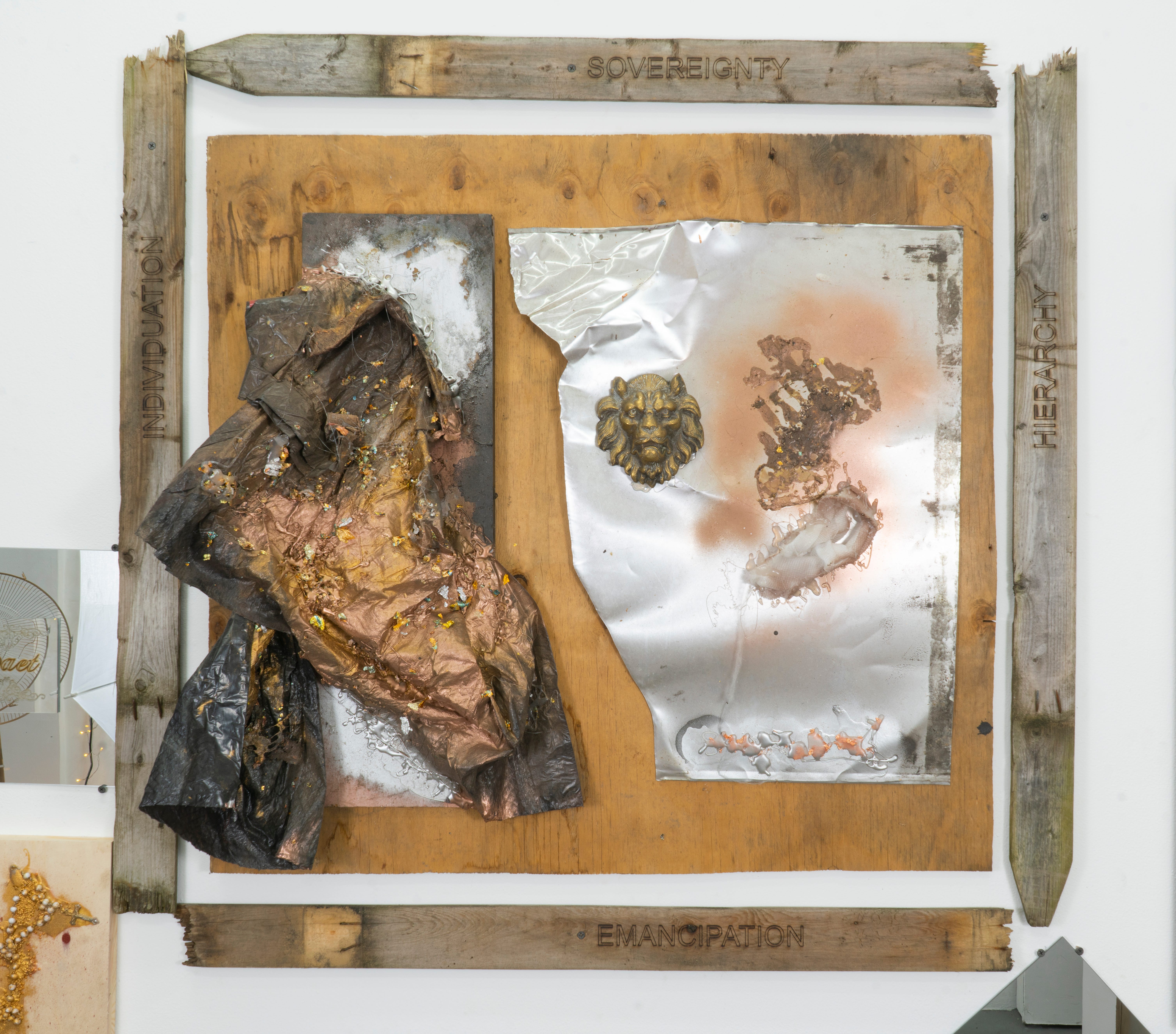
Introduction to Eschatology 2022
39 x 39 x 7
Laser-etched discarded wooden balusters, found furniture panel, trash bag, reclaimed aluminum sheet, melt-adhesive glue, spray paint, metal leaf flakes, medical gauze, found belt buckle, reclaimed plywood
This piece is another work that serves as a pointer to an Arena of Transcendental Qabala; you can partially trace the development of my Eschatology on this feed from my old arkwork.org website. (Eschatology is the fourth Arena of the system, and its fulfillment - following Axiology, Metaphysics and Cosmogony, all of which have pieces in this show that I've already noted).
Heaven, which my cosmogonical mythopoeia designates as “The Armistice of Haelegen” is a world where no suffering goes unredeemed1, and where, instead of laws and rights, the reigning principles are responsibility and mercy. The theoretical resources I draw upon to define it come from the humanist domain (Fourier, Marx, Klossowski) as well as the theological domain, above all the work of the 18th century Islamic theologian Mullah Sadra, who developed a crucial and extremely nuanced theory of the imaginal realm.2
The mode of value that will rule heaven’s economy with be neither use value nor exchange value, it will be intrinsic value, or what Plato calls “the coin that cannot be exchanged”. In other words, dignity.
Heaven will be a world where all forms of government that have ever been tried will be subsumed in a perfect marriage: the glory of monarchy, the logistics of the private sector, and, subsuming these, the strenuous, conflictual advance of civil liberties and egalitarianism that is so unique to democracy, which is humanity’s highest achievement, the history of which has barely begun. It will be characterized by the compassion, tolerance and ever-deepening intimacy that characterizes friendship or true love at its best, and its citizens will all be composers - they will be engaged in processes of self-realization equal parts intuitive and deliberate in just the way one imagines the work of an artist to unfold; but they will be fashioning their society, one another, themselves.
How will we get there? Obviously I can’t tell you that, but I hope and believe that the world I describe will have as real and concrete an existence as today’s world does. We don’t lack for an engine to transform the present. Whether anyone likes it or not, a process is under way by which science and industry are transforming society to a degree that is genuinely beyond imagination, potentially uprooting everything we take for granted, and in doing so it is harnessing our own desires, identities and opinions in ways that most of us don’t fully grasp or are unwilling to face. I don’t think there’s any reason to celebrate this fact (though neither do I know of an objective criterion for condemning it), but I do think it’s worth recognizing it for what it is, and maturing out of any illusion that any one group of people can stop it. My vision of Haelegen is ultimately meant to exist as an ideal to strive towards within the small arena of freedom that we do have, so as to make the most of the positive affordances of our moment. My hope would be for it to direct attention towards the possibility of real love and fulfillment, and to stand opposed to other stances towards the present which I deem either fruitless or cruel, and which are any any case intellectually groundless.
The lion head in the piece represents the Meek King, the monarch of Heaven who rules by compassionate example, a trusted servant. The words engraved in the balusters refer to the four guiding principles of heaven’s society: sovereignty, hierarchy, emancipation, and individuation. Sovereignty is a mutual recognition of the autonomy and dignity of every human being, with an eye towards a collective transcendence of exogenous and heteronomous motivation (laws, whether social, physical or logical), ever approaching a living, integrated unity. Hierarchy is a logistical matrix that ensures every need that arises is coordinated with that which satisfies it, as much as possible - whether that need is material, emotional, existential or educational - and the ability of every human to gladly take on unique personal responsibility rather than be motivated by shame or fear. Emancipation is the expansion of civil rights through contemporary intersectionality towards the infinite and the unforeseen, the compassionate ongoing renegotiation of norms in light of the evolution of souls and communities. Individuation is the process of unique creative unfoldment which is the bedrock of the whole civilization, the gradual discovery by each human being of their unique gift, the simultaneous sharing of its fruits, and the cascade of inspiration that follows.
I find that so often people3 are aligned with one of two opposing strata that interlock to form what is best understood as a collective ‘complex’ or ‘false self’ in psychoanalysis.4 Some align with a moralism about politics that isn’t so much wrong as it is hopeless, because it has no connection to the real levers of power - the opinions and critiques might be mostly correct, but if they move beyond the form of commentary (which is increasingly rare), the organizing is always short-lived and hesitant about both its strategies and its tactics, and necessarily so, since neither have traction on our actual reality. Those who have grown tired of this tendency (or never believed in it in the first place) are inclined to throw up their hands and give up on the idea of social justice, to be “evil” in a way that from the inside seems counterintuitively “good” because it’s vital or free, but it’s actually playing its part in perfect coordination with moralism to sustain slavery - these are just the two sides of the Lacanian fantasy, the moral persona and the illicit drive; they’re both illusions, they charge one another with energy. Really, they’re both moralism. True freedom comes when one breaks free from this nexus of bad faith all together and makes contact with the concrete reality of love, the True Vine, which comes from God, and ripens in accordance with its own laws.5
What does it mean to transcend humanism? Some seem to imagine that this means to dissolve identity and personal concern, to cast out self respect and mutual respect, to degrade the self, to accept brutality, coldness, division, and the idea is that this is called for by virtue of ineluctable acceleration, fantasizing that it’s making contact with an imaginary vital flux that will counterintuitively redeem and fulfill us if we have the courage for the ride. In all seriousness - this comes from a sick place6 - there is no useful argument against it other than healing, which God provides when we relate to him authentically. Transcendental Qabala isn’t a goldilocks zone or a compromise between extremes; there is sickness and delusion everywhere, Transcendental Qabala is a cure. What most contemporary political stances in the present share, regardless of orientation, is a lack of grounding in an ecstatic apprehension of the unfathomable sanctity of the human soul and its capacity to feel and grow. I think it’s mostly because of trauma and fear; people don’t really understand that radical love is possible because they’ve never experienced it. Maybe they’ve only or mostly known toxicity. As a result, there’s a widespread desire to cling to or idealize earlier stages of human self-organization, a desire to devolve into structures that that the human spirit wore before the rise of liberal democracy, rather than to improve upon and perhaps transcend liberal democracy by incorporating only the aspects of those forms that are compatible with universal respect. 7 Some might try to justify antihumanism using rhetoric along the lines that values like Truth, Goodness, Beauty and Justice are outdated, that we need entirely new values for a new aeon, qualitatively different entirely - but this is sophistry; it isn’t really transparent to itself, doesn’t see that it’s actually just justifying regression. Post-humanism should enhance and refine that which we most associate with the human - its “humane” quality and its constructive quality - not abandon it or manufacture contorted critiques that supposedly analyze it out of existence, rendering it void on specious ontological ground or on the grounds of a (moral) critique of whatever hypocrisy has been humanism’s shadow.8
Suffering goes on just as it does in our world, but none of it is fruitless.
Two important notes about Sadra. He’s notably not a Christian, even though I am; his work is useful to me nevertheless, both because Christianity is larger than the explicit Christian tradition, and because ultimately a radically ecumenical approach is required for Christianity to be truly authentic. In heaven, there will be no more Christianity, and Christ will go by some other name (more specifically, his name will be “The Meek King”). Also, part of Sadra’s importance is that he was a contemporary of Descartes, and, because he was living in Persia, where God had not died at that time, he independently intuited many modern philosophical innovations proper to that era, but incorporated them into Islamic theology (during a time when Christian theology was grinding to a halt). Especially as regards the nature of cognition, he actually anticipated some of what Kant is most celebrated for, and even anticipated some of Deleuze’s insights regarding materialist transcendental temporality (the evolution of substances).
especially in online theory and experimental culture circles.
I encourage you to pay attention to the nuance of this analysis. It’s not widely recognized that a complex requires both a false moral exterior and an interior transgressive fantasy. (Or you could swap these to make it look more familiar - an inner moral citadel and a ‘wild’ outside, it’s all the same). From the perspective of either of these, the other is the enemy. But the psychoanalytic cure offers us the insight that they’re both, together the - you thought I would say enemy, but in fact the cure awakens a higher compassion that sees no enemies, only people who are suffering and in need of love.
See the work of Michel Henry, especially I am the Truth: Towards a Philosophy of Christianity
So many people are active online, and even do such interesting, genuinely valuable things, precisely because they are sick.
It matters very little whether these imagined earlier stages are “indigenous” and “tribal”, or associated with the “traditional family” or “natural authority”; its the same tendency of regression, the fantasy chosen has more to do with one’s circumstances than anything else
Theoretical resources that support this view tend to have less cache, but not because they’re any less intelligent. See the work of Karen Horney and Merle Fossum
https://youtu.be/DXthC8garYo Transgender cyborg angels flock across the sky, non-op and post-op, roosting in alabaster hives.
Their blood is laced with nanobots and mineral oil, they have prosthetic limbs and exoskeletons, and glittering metal wings. There are computer chips in their brains. Their augmentations are hardly elegant, glass and bronze and plastic, but are humbly kitsch.
Not even the animals hurt each other.